



Arbitration Agreements in Employment Contracts: Be Careful What You Sign
If you must sign an employment contract to get a job, it is likely to contain an arbitration clause requiring you to resolve any contract disputes with your employer through arbitration instead of traditional litigation.
Arbitration is an alternative dispute resolution method in which a neutral third party hears and decides legal disputes. Arbitration is typically binding, limiting the right to appeal a dissatisfactory decision.
There are advantages to arbitration, such as lower costs, quicker decisions, and privacy. However, arbitrator decisions do not create precedents. You can’t count on similar resolutions of similar cases through the arbitration process. There is also less of a discovery process in which each side gathers evidence from the other. This potentially reduces your ability to gather evidence needed to support your case.
Once executed, an employment contract in Florida is legally binding, including one with an arbitration clause. An experienced Tallahassee employment contract attorney at Cruz Law Firm can review your employment contract and help you understand an arbitration provision and your legal options.
To Sign or Not to Sign: Navigating Arbitration Agreements
In arbitration, workplace disputes are submitted to one or more arbitrators who make a binding decision to settle the dispute. Arbitrators are specially trained and experienced neutral third parties. Many are retired judges. The arbitration process is like an informal court case. Each side presents evidence and testimony. The opposing sides may cross-examine the witnesses. Lawyers represent the employee and employer and present their cases.
Both parties must agree to have the arbitrator hear their dispute and to abide by the arbitrator’s decision. The consent to submit workplace disputes to arbitration is often obtained when an employee is hired. An out-of-work job candidate who is told they can sign an employment contract containing an arbitration agreement or decline the job may not feel like they are volunteering.
State and federal courts, including the U.S. Supreme Court, have repeatedly upheld the validity of mandatory arbitration clauses. Florida law says that “an agreement … to submit to arbitration any existing or subsequent controversy arising between the parties to the agreement is valid, enforceable, and irrevocable except upon a ground that exists at law or in equity for the revocation of a contract.”
A federal law enacted in 2022 makes it illegal for employers to require employees to arbitrate disputes related to sexual assault or sexual harassment.
Impact of Arbitration Agreements on Employee Rights
By signing an employment arbitration agreement, you give up your right to go to court and have a jury trial to resolve job-related issues such as wrongful termination, breach of contract, or hostile work environment. Instead, you agree to submit any future dispute to arbitration rather than to a court of law.
Arbitration can be a valid way of resolving disputes, but research has found that mandatory arbitration has a tendency to suppress claims. There is also evidence that mandatory arbitration produces outcomes different from those of litigation, to the disadvantage of employees.
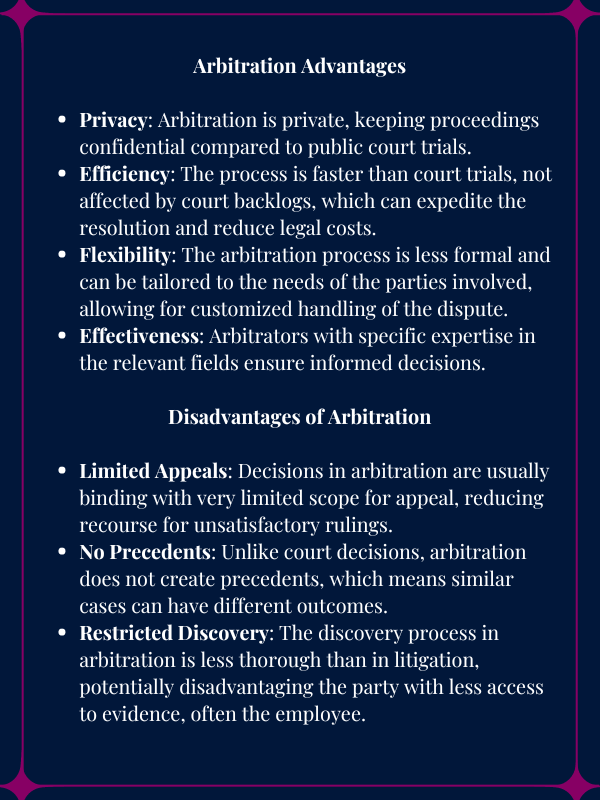
The positive points of arbitration for the employee include
- Privacy: Court trials are public proceedings. Anyone can attend or access records of the trial through the court system. Arbitration is private. There are no outsiders involved, and no records of the proceedings are available to individuals, other employers, or the press later.
- Efficiency: Arbitration is not subject to backlogged court schedules, and the process is quicker than formal court proceedings. Issues can be resolved in several weeks instead of stretching into a year or more. The faster process also saves on the cost of attorney’s fees and preparing and filing documents.
- Informal and Flexible: Arbitration is less formal than court proceedings. The arbitrator and parties to the dispute can design the arbitration process to accommodate their respective needs. Issues like the nature and scope of discovery, the conduct of the hearing, and the length of time for the entire process are up for discussion.
- Effectiveness: Arbitration can lead to just decisions, and often does. Arbitrators are often chosen for their expertise in the relevant field, ensuring that someone with a deep understanding of the subject matter hears the case.
The downside of arbitration includes
- Limited Appeals. An arbitration decision is usually binding. The ability to appeal arbitration decisions is more limited than pursuing appeals of court decisions.
- Lack of Precedent: Courts rely on “case law,” the results of previous decisions in similar cases. This gives you an idea of how a judge will rule. Arbitrators are not bound by previous decisions. Similar cases may be decided differently in different arbitration proceedings.
- Lack of Formal Discovery: Discovery is a process in which each side in a court case obtains evidence from the other side through depositions and document requests. Discovery in arbitration is limited, which could adversely affect your ability to make your case. The employer will typically have better access to documents and other evidence pertaining to the dispute than the employee.
If you are already in a dispute with your employer that is headed to arbitration, the employment law attorneys at Cruz Law can help you prepare your case and ensure your rights are upheld during these proceedings.
Florida Laws on Arbitration Agreements
Florida law generally supports the validity of employment arbitration agreements. However, there are some legal grounds on which these agreements may be challenged. These include:
- Lack of voluntary consent—If an employee is pressured or coerced into signing such an agreement, it may be ruled invalid.
- Unfair terms — If the terms strongly favor one party to the agreement, a court may rule that the agreement is unconscionable and unenforceable.
Arbitration agreements waive an employee’s right to a jury trial as a means of dispute resolution. The waiver of the right to trial, if voluntarily granted, does not provide a basis for ruling an arbitration clause unenforceable.
Before Signing an Employer’s Arbitration Agreement
You should read your entire employment contract and the employee handbook before signing an arbitration agreement or entering an employment relationship. New employees are often directed to sign standard employment forms that say they have read and understand everything contained in the employee handbook. Many people sign these forms with little thought, but your signature binds you to the contents of the handbook.
It can be tough to question a new employer who is offering you a job. But you have rights. If you are a non-union worker with skills in high demand or in an executive position, you may have some bargaining power to negotiate your terms of employment.
Any new employee should ask for time to read the documents carefully to make informed decisions. Ask whether your contract or the employee handbook contains a mandatory arbitration clause. You should feel comfortable saying that you’ll need to have your lawyer review the legal language of an employment contract.
Contact Cruz Law in Tallahassee for an initial consultation and review of your employment documents. If we have the opportunity to negotiate an employment contract for you that must contain an arbitration clause, we will seek:
- Cost of Arbitration. The employer who demands arbitration should bear all costs of arbitration, including your attorneys’ fees.
- Choice of arbitrator. Employers typically work from a local roster of retirees certified as arbitrators and the types of cases they are willing to hear. As you and your employer settle on who will hear your case, you should each have the right to reject at least one arbitrator without providing a reason.
- Arbitrator’s disclosure. Prospective arbitrators should be required to disclose any business or personal interests that could indicate a conflict of interest.
- Right to legal counsel. The language that requires you to enter arbitration should state that you have the right to have an attorney represent you in all aspects of the arbitration procedures.
- Right to damages. Since your employer has dictated the dispute resolution process available to you, you should be allowed damages for all aspects of harm if the case is decided in your favor. This should include restitution of all lost compensation and costs, as well as compensation for the harm to you and your reputation and for your emotional distress.
Contact a Tallahassee Employment Contract Lawyer

If your employer has made an arbitration agreement a condition of your employment in Florida, an employee rights attorney at Cruz Law Firm can help make sure that the employment agreement does not trample on your rights. We can review your employment agreement and other documents to ensure their legality and to negotiate options that provide better protection to you. If you are already headed for forced arbitration of a dispute with your employer, we can protect your rights and potentially demand compensation for your monetary losses and for your emotional distress.
The Cruz Law Firm is committed to providing our clients with dedicated, effective legal representation and personalized service, no matter how complex the issues they face. Our attorneys represent hard-working people like you in Tallahassee, Jacksonville, and across the Florida Panhandle.
Contact a Tallahassee employment contract attorney with our law firm today for a confidential consultation about your legal options and how we can protect your rights during this difficult time.

They were extremely compassionate during a time that was incredibly difficult for me and my family. I am so grateful to this law firm. To them you are more than just a client.

They were quick to respond and asked for specific details around my inquiry. They are great! They went above and beyond to help me get my questions answered. I would highly recommend them to anyone looking for a great firm.
If I was looking for an employment law firm, Tiffany Cruz and her team would be the first place I’d look. Everyone from receptionists, to the wonderful (!) office manager and associates will make you feel taken care of and welcome.
How the evidence was presented, how information was brought forward, and how the courtroom engagement from Tiffany and The Cruz Law team was kept to a highly professional level, was outstanding. Even more remarkable was the way things were laid out in such a strategic way to help my loved one’s case.
Tiffany represented me during a very trying time. Her dedication to my case and my best interest surpassed my expectations. When someone needs an attorney it is usually a rather emotional time. To have complete confidence in your attorney is the best.
If you're looking for a great attorney, who is extremely knowledgeable and will fight hard for you, look no further!! As a single mom I just felt defeated and that there was no way I was going to get the money owed to me. That was until I met Tiffany.
Tiffany gave me great counsel through a rough time in my employment career. She was very caring, honest, and transparent in her assessment and followed up with me on multiple occasions to make sure I was protecting myself through the process. Thanks!
I highly recommend Tiffany Cruz. She is courteous, professional, and understanding of the employment law. Her outstanding negotiation skills resulted in a swift and fair outcome.





Author: Cruz Law Firm P.A.
At Cruz Law Firm, P.A., we represent employees in Tallahassee, Jacksonville, and throughout the Florida Panhandle. We’ll fight to protect your employment rights, from workplace discrimination and sexual harassment to wrongful termination and whistleblower claims. Let us put our experience to work for you.
Proudly serving
Tallahassee, Jacksonville,
and the Florida Panhandle
325 N. Calhoun StreetTallahassee, FL 32301(850) 701-8838


